
Documenting the WWII Fallen of Toronto's Elementary Schools
William Segriff

Bill Segriff came from an old Toronto family. His grandfather Patrick Segriff was born in Toronto in 1841 to Irish Catholic immigrants. In the 1860s he married Mary Vine Thompson. She was 4 years younger than Patrick and the couple bought some land near the Danforth, (situated two lots north of the Playter Estate, near what is now Pape and Mortimer) which at the time was outside of Toronto's city limits and was a suburban village called Doncaster. Patrick worked as a cattle drover and butcher. He was a member of a Temperance organization and The Globe newspaper reported in August 1874 about the organization's “pic-nic at Playter's Grove, a very pleasant situated spot, lying just south of the village.” Patrick was a judge of the games.

Patrick Segriff, circa 1880. From www.findagrave.com.
The couple had at least eleven children and Bill's father Ernest Albert Segriff was one of the youngest, born in 1882. Many of Ernest's brothers became market gardeners in East York. His sister, Ella, married Fred Cosburn whose family name was given to Cosburn Avenue.
Patrick and Mary moved to Norway village in the early 1900s. Situated at Woodbine Avenue and Kingston Road, it was a small community with a saw mill, a post office, school, church, hotel and stores. The Segriffs moved into 320 Kingston Road, the post office which had been built in 1866. Patrick had a butcher shop and their daughter Fidelia eventually ran the post office. Patrick died in 1906, buried as a Catholic. Mary died in 1913 and she was buried in Norway cemetery. None of the children were raised as Catholics. Mary's estate included most of the real estate on the north side of Kingston Road in the block east of Woodbine which was sold off in 1920.
On December 10, 1910 Ernest married Ella Constable (b. 1885), part of a family of market gardeners. Her father Thomas worked as a baker in the family bakery and confectionery business which was located on Queen Street West near Augusta. Her brothers were market gardeners on Pape Avenue in East York. In 1908 she had a job as a sealer at W J Gage, a text book publisher that was located on Spadina Avenue and she lived with one of her brothers.
Ernest was partners with his brothers George and Thomas. The Segriff Brothers market garden was located on the north side of Plains Road at Woodbine. Initially Ernest's family lived in a house on Plains Road, but they moved to 1405 Woodbine Avenue at the corner of Bracebridge Avenue to house their twelve children. Bill was born on November 28, 1924, the fifth of seven sons and the eighth child. Unlike families in the newer parts of the neighbourhood, the Segriffs kept some livestock, including a pet Shetland pony called Dolly that they acquired in 1914 and was still living with them in 1932. Ella ran an ice cream parlour on the main floor of the building. The family were members of the Wexford United Church on Lawrence Avenue east of Warden.
Bill went to Danforth Park school until he was 14, in Grade 7. He had to leave school to help in his father's market garden. There he worked for two years, then spent five months laying concrete. Until he enlisted, he was working in various market gardens in the area. He liked to skate and box. As an agricultural worker, he wasn't required to enlist in the forces once he was old enough to join up. However, Bill enlisted in the army on January 5, 1944. After his initial interviews, the recruiting officer said that Bill “seems very sincere and has a likeable personality.” He wanted to join the Tank Corps, but because the force was full, he was thought to be suitable for the infantry.
By the end of January, Bill was at the Basic Training Centre in Yarmouth, Nova Scotia. He returned to Ontario, to Camp Borden near Barrie, to continue his training and take machine gun courses. When he completed his training in the middle of June, the D-Day invasion had taken place and the need for reinforcements was growing. Bill had his embarkation leave from June 19 until July 2, then he reported to Halifax, embarking on July 20. He arrived in Britain on July 27 and when he was processed through the Canadian Infantry Reinforcement Unit, he stated that he was very anxious to get automotive work.
Bill was sent across the Channel to France by August 12. Two days later he joined the 1st Battalion of the Royal Highland Regiment, otherwise known as The Black Watch. It is a regiment based in Montreal and had taken part in the disastrous Dieppe Raid in August 1942. In 1944, the regiment had arrived in France a month after D-Day and was part of the Canadian 5th Infantry Brigade with Le Regiment de Maisonneuve and The Calgary Highlanders. On July 25, three weeks before Bill joined them, the Black Watch had been decimated at the Battle of Verrières Ridge. Of the 325 men who advanced that day, only 15 returned unscathed. Bill was one of the reinforcements to get the regiment back to fighting strength. When one considers that other Danforth Park Honour Roll members spent up to two years training for the European invasion, there was a lot of concern among the officers that the reinforcements were not fully trained for battle.
Bill found the regiment camped a few kilometres north of Falaise, about 50 kilometres inland from Juno Beach. The final push to take Falaise had commenced the previous evening. The regiment wasn't called to battle and the first few days were spent training. On the 16th, the regiment's war diary stated: “This evening C. Coy under Maj. Pinkham was despatched to clear Quesnay Woods in our rear. The boys, most of them new reinforcements, galloped through firing their weapons at every conceivable type of cover. Net result, no Jerries in wood, but a good time was had by all.”
On the 16th, the regiment moved to a point northeast of Falaise to relieve the Canadian Scottish Regiment. The Falaise gap, cutting off the Germans, was to be closed within twelve hours, but the Black Watch, rather than be part of the offensive, was herding prisoners of war. With the gap finally closed, the push was northeast to the Seine River. The regiment ran into some enemy opposition in the late afternoon of the 21st and two days later the men were shelled by the Germans, suffering several casualties. The Black Watch was moving 30 to 40 kilometres per day. On the 25th the Americans liberated Paris.
The Black Watch was five kilometres from the Seine, advancing on the town of Bourgtheroulde in the early hours of August 26. The men battled snipers and machine gun fire. Eventually the brigade decided to attack from the rear of the enemy, which proved successful. They became a target for heavy mortar and shell fire but before they could retaliate, several men were killed, including many of the prisoners of war lined up outside the brigade headquarters. Two days later the regiment moved forward to the banks of the Seine in the Forêt de la Londe and were heavily mortared.
On August 30 as they moved through Elbeuf, they were cheered by the locals and crossed the Seine. The next day they rode through Rouen where the war diary recorded that “the civilians lined both sides of the street, throwing flowers, kisses and fruit and madly, gladly reaching up to shake as many hands as they could reach.” The Black Watch was the first complete unit to pass through the city.
They continued north towards Dieppe, which brought back bad memories for the few veterans of the regiment. Although the regiment was camped southeast of the town, many were given permission to visit Dieppe and remarked on the difference arriving there in peace. On September 3, the fifth anniversary of the beginning of the war, the 2nd Division had a victory parade through the town with people thronging the sidewalks, cheering wildly. Bill and the regiment marched six men abreast. The war diary recorded: “As we neared the saluting base the cheers increased and the edges of the route were a black mass of people. We rounded a corner and the pipe band by the saluting base broke into the strains of 'Hielan' Laddie.'”
The next day rumours were flying around of a long move, probably to Antwerp or Dunkirk. Training continued. On the 6th the short respite was over and the regiment pushed north, coming up against German shelling. The Germans had blown canal banks, flooding much of the land and putting many of the roads under water. The regiment was assigned to contain the enemy in the area around Dunkirk. Since the ground was so spongy, the heavy artillery was useless. They withstood more enemy shelling and began to suspect that the enemy in Dunkirk had turned their coastal guns inland. At 0330 hrs on the 14th, the regiment was ordered to move because the Maisonneuves were relieving them. The Black Watch had several days to relax, have a shower, write letters home and blow off some steam.
They crossed into Belgium on September 18 and set up camp just outside of Antwerp on the west bank of the Albert Canal which connects Antwerp to Liege. The enemy were on the other bank. The regiment was to patrol at night to prevent the enemy from blowing the locks and flooding the land. During the day the men kept under cover to prevent drawing fire from the snipers. They eventually moved into a fort outside of Antwerp where they continued training and were able to watch a movie in the evening if they weren't on patrol.

Map of The Battle of the Scheldt. The Black Watch served in the 2nd Canadian Division and moved north from Antwerp. C.P. Stacey, Official History of the Canadian Army in the Second World War, Vol. 3. Ottawa: Queen's Printer, 1960, page unknown.
On the 26th, they moved to what had been a hotel on the outskirts of Antwerp, 1400 metres from the enemy on the far bank of the Antwerp-Turnhout Canal. The Scheldt estuary, which connected Antwerp to the sea, was a critical prize for the Allies. The Allies needed the port at Antwerp for distribution of supplies for the winter, as all supplies up to this point had been flowing from Normandy. On September 28, the Canadians were tasked with cutting off the German forces to the west from the rest of their army. The Black Watch as part of the 2nd Canadian Infantry Division, crossed the Antwerp-Turnhout Canal. They needed to capture the town of Woensdrecht which would cut off the Germans on the South Beveland peninsula, which lined the north side of the Scheldt. It was a slow and bloody advance and the regiment moved into Brecht, northeast of Antwerp, by October 1. The regiment held its position for several days, under continual shelling. The Black Watch was relieved on October 5 by the South Saskatchewan Regiment and it was welcome after seven days of being under constant fire. The Black Watch had suffered 119 dead or wounded.
During the previous battle, the regiment received 96 reinforcements, but 55 of them were not infantrymen. They were cooks, bricklayers and other specialists, concerning the officers once again. The regiment moved north toward the Dutch border, crossing it on the 7th. They were under constant heavy mortaring and shelling but fortunately did not sustain many casualties. A major push was made the next day with the Maisonneuves and the Calgary Regiment, fighting for every inch of the advance. They realized they were up against the best the Germans had to offer – paratroop battalions along with some glider and Luftwaffe personnel. For every German counter-attack, the Canadians held their ground and on the 10th, the regiment was relieved by the Royal Hamilton Light Infantry and had their first full night's sleep in four days. In those days of fighting, the regiment lost another 81 dead or wounded.

The movements of the Canadian 5th Infantry Brigade at Woensdrecht. From C.P. Stacey, The Victory Campaign: The Operations in Northwest Europe, Vol. 3, Ottawa: Queen's Printer, 1960, p. 381.
On Friday October 13, Operation Angus was launched to cut off the isthmus of South Beveland from the mainland. The area was known as “the Coffin” because of its shape on the map. The Germans held positions on a raised railway embankment near the village of Hoogerheide and the battalion advanced across 1100 metres of beet fields. At 0615 hrs, the battalion attacked, supported by artillery and heavy mortar. Bill was a member of A Company. C Company reported at 0655 hrs that they were over 200 metres past the start line and encountering small arms fire. They were helped along by covering mortar fire and at 0705 hrs they were held up again, this time by machine guns. The delay of C Company jeopardized the success of the operation and the safety of the regiment. Soon most of the troops out front were pinned down and by 1110 hrs, the regiment retreated. A second attack began at 1700 hrs but met with heavy German resistance. Major Ewing of A Company reported to headquarters. The war diary reported: “He had been wounded, and was nigh exhausted but insisted on making a report. His information was that A Coy had not been successful in reaching their objective, that casualties had been extremely heavy and that few of the Company would come out alive.” At 0100 hrs on the 14th, the battalion was withdrawn.
The day was referred to as “Black Friday” by the regiment. The losses were a blow. “A” Company, a unit of 90 men, only had four unscathed. The Black Watch totalled fifty-six men killed that day, including Bill. History has recorded that Canada's Black Watch regiment was one of the unluckiest Canadian units, suffering more casualties than any other in the war.
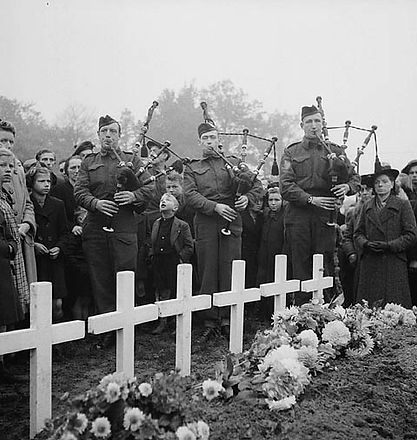
The Black Watch pipers playing at the burial of the infantrymen lost on Black Friday. Note the local people paying their respects. Ossendrecht, Netherlands, October 26, 1944. From www.pipesforfreedom.com.
Bill is buried in Bergen-Op-Zoom Canadian War Cemetery, where Danforth Park alumnus Frank Montgomery lies. By 1950 the Segriffs were no longer in market gardening as East York was being developed for housing. Ernest Segriff was working for Silverwoods Dairy. He passed away in 1965 and Ella followed in 1972. The Segriff family were still living at the corner of Woodbine and Bracebridge in 1976.
Listed in Bill's effects was a Ronson lighter engraved “Bill from Jean.” A year after Bill's death, The Toronto Star carried this Active Service In Memoriam:

The Toronto Star, October 13, 1945.