
Documenting the WWII Fallen of Toronto's Elementary Schools
Frank Charles Montgomery

Frank Montgomery's parents came from Ontario farming families. His father Robert Ivan Montgomery was born in Midland in 1893 and his mother Edith Louisa Turl was born 10 kilometres south, in Waverley in 1898. When the couple married on September 2, 1922, Robert was living halfway between Waverley and Midland, in Wyebridge. When Frank was born on December 15, it was in a house on Doncaster Avenue in East York. Robert and Edith lost three children in infancy but the family was finally completed with Ivy Marie in 1926 and Luella Matilda in 1927. The Montgomerys hopped around the neighbourhood, living at 23 Hamstead Avenue in 1924 (no longer standing), 23 Everett Crescent in 1925 and finally settling at 306 Westlake Avenue in 1926. Robert also changed jobs frequently, working at a mill at the foot of Jarvis Street, at Goodyear Tire and as a labourer at a concrete company.
Frank began school at Danforth Park in 1928, wearing glasses until he was 8 years old to correct a squint. He was a boy who liked sports and liked to play, but only moderately. He graduated from Danforth Park in 1936 and attended East York Collegiate until 1940. He played baseball, football, basketball, rugby and hockey and was knocked out in a hockey game in 1940. Since both his parents' families remained in the Midland area, visits to the farms were frequent and Frank helped out.

Frank's uncle, Joseph Charles Montgomery (1891-1917). Source: The Canadian Virtual War Memorial.
Once he left school, Frank found work for a month at the Don Valley Paper Mill at what is now Todmorden Mills, but he quit to study at the RCAF's Galt Aircraft School. He roomed in Galt while he took an aircraft mechanics' course in the local high school. Frank had spent a couple of hours as a passenger in a plane and wanted to do something for the war effort. His father had lost his brother, Joseph in World War I and Frank wanted to join the RCAF. In 1940 the force wasn't taking anyone who wasn't a university graduate or a pilot, so Frank saw the aircraft school as an alternate way to join the air force.
Frank studied there for a year and a half with the exception of five months from July to November 1940 which he spent in Herschel, Saskatchewan using his farming skills as a tractor driver to help with the harvest. It was 80 kilometres southwest of Saskatoon and he was filling in because so many of the farm workers had gone to war.
Frank enlisted on July 14, 1941 as an air engine mechanic and worked out of Malton (now Pearson) airport. The next month he was sent to Winnipeg. The RCAF training schools needed mechanics to keep the aircraft functioning. In October, he was in a Winnipeg hospital having his tonsils and adenoids removed because he'd been experiencing chronic sore throats.
By September, 1942, Frank wanted a change from the air mechanics' stream and signed up to qualify for aircrew so he could get overseas and fight. By this point he'd clocked over twenty hours as a passenger in a plane. He was immediately sent to No. 2 Initial Training School in Regina where he remained until November 7. Here the new recruits were tested to see if they could be pilots. Frank lacked the co-ordination to be a pilot, but it was felt that he could be a navigator. His instructor wrote, “He is conscientious, willing and co-operative.” From November 23 to March 19, 1943 Frank took the air navigators' course at No. 7 Air Observer School in Portage la Prairie, Manitoba. He failed the course and his instructors felt that he was shy and lacked self confidence. He was passed along to No. 2 Bombing and Gunnery School in Mossbank, Saskatchewan from March 8 to May 30 and proved to be an above average gunner, placing 7th in a class of 41.
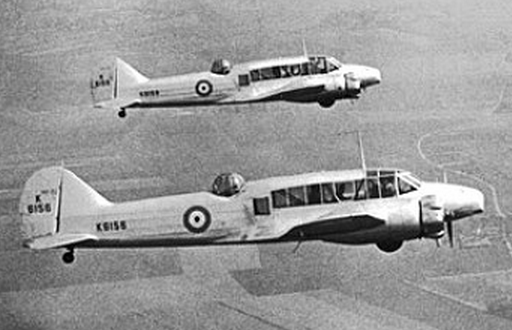
Avro Ansons. From www.sillothairfield.wordpress.com.
Having graduated as a gunner, he was able to have two weeks in Ontario with his family from July 7 to 23 before he had to report to Halifax. From there he was sent to New York where he caught a troop ship on August 3. He arrived in Britain on August 11 and was in Bournemouth at the Personnel Reception Centre which sent him to the No. 1 Advanced Flying Unit for observers on August 31. It was located in Wigtown in southwest Scotland and using Avro Anson aircraft, which were standard at the RCAF schools in Canada. He was learning navigation techniques specific to Britain and Europe. Once that course was completed, Frank continued to No. 14 Operational Training Unit (OTU) at Market Harborough in central England on October 19. He joined a crew training on Wellington night bombers. He continued his air bomber training – basic & cross country - and was considered keen by his instructors. He moved briefly to No. 26 OTU near what is now London's Stansted Airport and then to a group aircrew school 25 kilometres from Cambridge on March 25 to learn to fly in the Lancaster heavy bomber. The Lancaster was now the standard heavy night bomber of the Allied forces. Frank as an air bomber was located in the nose of the plane, lying on his stomach to operate the sights of the bombing equipment. On May 26, Frank and his pilot Alan Smith joined the 622 Squadron. It's unclear whether the rest of the crew arrived with them or whether the crew was assembled in the squadron.

Lancaster bomber, 1944. Bomber Frank would have been in the nose bubble. From www.roll-of-honour.com.
The 622 is an RAF squadron and during WWII it was located at RAF Middenhall, about 40 kilometres northeast of Cambridge. The squadron motto is Bellamus Noctu “We wage war by night.” Frank and Alan Smith's crew contained navigator John Chigwidden, a 33 year old Australian, wireless operator Francis Brandon, Edward O'Connor who was the middle gunner, rear gunner Jack Spencer and flight engineer Reginald Lewis who was 28 years old. Smith, Brandon, O'Connor, Spencer and Lewis were Englishmen. D-Day was eleven days away and the Allies were bombing many French targets in preparation for the invasion.

Lancaster bomber on a test flight, February 14, 1944. A better view of the air bomber's bubble. From www.warhistoryonline.com.
Frank's crew's first mission was on May 30, to bomb the port city of Boulogne. Their Lancaster took off at 2300 hrs and landed safely at 0105 hrs, having dropped their bombs at 0007 hrs from 2,000 metres. The next night the target was Trappes near Paris. The squadron lost two Lancasters that night. At the stroke of midnight on D-Day, Frank's Lancaster took off for Lisieux, dropping their bombs along the Seine River at 0139 hrs and landing again in Middenhall at 0330 hrs, three hours before the first landings on the Normandy beaches. The next day, they bombed the outskirts of Paris again. It was eight days before their next mission, to Valenciennes near the Belgian border. The crew had leave from June 21 to 26. When they returned, the Battle of Caen was raging. On June 30, they bombed Villers-Bocage, southwest of Caen. In July they bombed French targets on July 2, 3, 10 and 12. On July 18, they undertook a daylight raid on Caen, bombing canals and rivers at 0606 hrs.
On July 20, they were briefed that 15 Lancasters from the squadron would be taking part in a 158 aircraft bombing raid on the oil refinery in Homberg, Germany. Pilot Smith got them in the air at 2310 hrs. As the planes approached the target, they were intercepted by German night fighters. It is uncertain whether Frank's plane reached the target. At 0140 hrs the Lancaster crashed at Dongen, Netherlands, killing all onboard. It had been shot down by Oberleutnant Dietrich Schmidt, a German ace who already had at least 18 victories. Twenty Allied planes were shot down that night, with two lost from Squadron 622.

Frank's grave, Bergen-Op-Zoom Canadian War Cemetery. From The Canadian Virtual War Memorial.
Frank is buried in Bergen-Op-Zoom Canadian War Cemetery, the resting place of another Danforth Park alumnus, William Segriff. Frank's parents lived at 306 Westlake until the late 1950s when they retired to Vesey, Ontario, a village a few miles from where they grew up. It is unknown when Edith died, but Robert passed away in 1982.