
Documenting the WWII Fallen of Toronto's Elementary Schools
Rodger Donald "Don" Mulholland

Don Mulholland's father George Burgess Mulholland was born in Ireland in 1888 and came to Toronto before the First World War to join his siblings Lillie and Sam who were already settled. Don's mother Christina “Cassie” Dow was born in 1889 east of Wasaga Beach, Ontario, the daughter of a Scottish blacksmith. She moved to Toronto around 1911 and worked as a waitress in a hotel on Yonge Street near what is now Yonge-Dundas Square and the next year she worked as a maid with board at the Gibson House hotel which was at Queen Street East and George Street. The couple married on February 27, 1914. George worked as a car cleaner for the Canadian National Railroad until 1920 when he found a job as a clerk at Eaton's department store at Queen and Yonge. He ultimately became a stock keeper and receiver.
George and Cassie's first son, Samuel John, was born in 1915, followed by Don on July 20, 1916 and Jean in 1918. The family lived in the east end, on Jones Avenue near Queen Street and then at 823 Erie Terrace, which is now called Craven Road, near Coxwell and the railroad tracks. By 1921, the Mulhollands bought a newly built house at 56 Wallington Avenue to accommodate their growing family. Three more children arrived – Albert Edward in 1920, William George in 1923 and Doreen May in 1929.
When Danforth Park school opened in 1922, the older Mulholland children attended. Don was a member of the Danforth Park swim team and in November 1928, he came second in the 12 year old boys' race in the annual swim meet against Secord. Danforth Park won the prize shield from Secord for the first time. (Secord's swim coach was Oliver Milton Martin, future principal of Danforth Park.) Don graduated with the Class of 1930. He continued to a tech course, probably at East York High School. He passed Grade 9, but left school in 1931 when he was 15. Don's brother Samuel was already working at Eaton's and George found a job for Don there. In the 1930s, Eaton's was a huge employer, owning most of the land between Bay and Yonge streets, from Queen to Dundas. There were warehouses and offices for their extensive mail order department. Eaton's also manufactured some of their products in these buildings. Don started out as a shipper with the company.

Postcard of Eaton's, looking northwest from Queen and Yonge, circa 1930. From Wikipedia.
n June 1935, 18 year old Don married Rose Ella Musselman and they moved to 108 Donlands Avenue. They had a daughter, Grace Carol, in the spring of 1936 and soon moved to 166 Oak Park Avenue, not far from Don's family. The marriage began to fall apart and the couple divorced in 1939. Don had custody of Grace and he moved them into his parents' house on Wallington. By 1940, Don was a foreman overseeing the manufacturing of Eaton's ladies' coats.
When World War II began in September 1939, young men started to join the forces. Although Don was a single parent to Grace and wouldn't have had to enlist, he joined the 30th Battery army reserve in November and ultimately enlisted with the 48th Highlanders on January 9, 1940. One can surmise that Don's divorce had affected him profoundly and he left Grace in the good care of his parents. Over the next two years, all of Don's brothers enlisted. Albert and William joined the Argyll and Sutherland Highlanders of Canada and Samuel signed up with the RCAF.
Don trained in Toronto as a rifleman and was shipped overseas as a reinforcement on May 10, landing at Liverpool. The 48th Highlanders Regiment had been in Britain since the previous December. By the time Don joined the regiment in late May, the Sitzkrieg (sitting war) had turned to Blitzkrieg (lightning war) with the Germans invading the Netherlands, Belgium and France in days. Between May 26 and June 4, approximately 350,000 British, French and Belgian troops were evacuated from the beach at Dunkirk, France and the course of the war was no longer in favour of the Allies. On June 6, the British cabinet decided to send an expeditionary force to France to fight the Germans. Captain Ted Brock arrived at the regiment with Don and wrote this for the BBC's World War 2 People's War archive:
On the 22nd May 1940, I arrived at the Corruna Barracks, Aldershot, fresh from Canada and just in time to see the brave remnants of the BEF (British Expeditionary Force) come straggling home from Dunkirk. I was then a Private Soldier with the 48th Highlanders of Canada and, less than a month later, on the 13th June found myself en route to almost certain death in collapsing France. We had been sent on a suicidal mission - which failed. Churchill hoped by sending fresh troops he could keep the French fighting. We landed at Brest and were en route to Paris when France capitulated. Only a miracle saved us when our Regiment found a small ship, the S.S. Biarritz at St Malo, which returned us to Southampton and back to Aldershot - with few casualties but all vehicles lost.
The regiment arrived back in England on the afternoon of June 16 and so began three years of training and a sitzkrieg of sorts for the forces. In August 1940, the Battle of Britain raged overhead as the German Luftwaffe unsuccessfully endeavoured to bring England to its knees in preparation for an invasion. Although not properly equipped with anti-aircraft guns, the 48th Highlanders destroyed a German aircraft with machine guns.
In September, Don's eyesight had worsened and he was issued glasses. Like all the Canadian regiments in Britain, the weeks were filled with training and every couple of months Don would have a week of privilege leave. On March 15, 1942 he was promoted to lance corporal and by May 4, to acting corporal. The promotion to corporal happened on August 5. On August 19, the ill-fated Dieppe Raid took place. The 48th Highlanders were not involved, but heard the grim news trickling in of the hundreds of Canadian killed or captured on the French coast.
When Don was appointed acting sergeant on April 7, 1943, the campaign in North Africa was coming to an end, with the Allies as the victors. The regiment's training had intensified and they were sent to Scotland for amphibious training. On June 13 they climbed on a ship at Gourock, Scotland and went to sea for almost a month. Once at sea, the destination was revealed as Sicily, off the south coast of Italy. An amphibious assault of 150,000 British, American and Canadian troops was launched early in the morning of July 10, 1943 on Sicily's south coast. The Italians gave little resistance and the Allies rapidly pushed inland.

Map of Sicilian battles of the 48th Highlanders, July-August 1943.
The regiment encountered formidable German resistance at Valguamera, a town of 10,000 inhabitants. On July 18, “D” company came under fire from enemy snipers and machine guns. By evening, the regiment crept into the town and found the Germans already had left.
As the forces moved farther inland, the rolling hills practically became mountains, giving the advantage to the enemy who knew how to use the geography to thwart the Allies. On July 21 The Hastings and Prince Edward Regiment were barely holding Assoro, a mountain-top town with only one road into it. The 48th Highlanders attacked from the west, forcing the enemy from the south-western approach for the town, enabling the road to be repaired and allowing the passage of tanks. The regiment linked up with The Hastings and Prince Edward Regiment by noon on July 22.
The regiment's next engagement was at Agira. The Canadians were to attack along six kilometres of highway leading to Catania and the enemy was defending the surrounding high ground. The Hastings and Prince Edward Regiment was the first to advance on July 25 and suffered 80 casualties, the highest single day loss in Sicily for the Canadians. Next, the 48th Highlanders were sent in and the lead company made it to its objective by the next evening, but reinforcements were prevented from arriving by heavy fire. The regiment withdrew.

Infantrymen of the 48th Highlanders of Canada advancing toward Adrano, Italy, August 18, 1943. From Library and Archives Canada.
On July 29, Don was promoted to sergeant and the regiment had a few days' rest. The final thrust of the Sicilian campaign was to break through the enemy line and take the town of Adrano. The terrain was rugged and supplies had to be brought in by mule. On August 2, several battles were fought in the Troina Valley which allowed the British to take the town by August 7. By August 11, the Germans began a full-scale evacuation to mainland Italy from Messina, leaving the Italians to fend for themselves and by August 17, the Sicilian campaign was over.
The troops were given a well deserved rest and the 48th Highlanders remained near the east coast of Sicily for several weeks. Most of the regiment landed on the southern coast of Italy at Reggio, on September 3, but Don was part of the rear battalion, which remained in Sicily. After morning parade on September 10, Don was put in charge of a swim parade to the ocean and a military transport truck left the camp with 22 men at 0900 hrs. Don was sitting in the passenger seat of the truck. Less than half an hour after leaving camp, the truck was side-swiped by a truck in an oncoming convoy. Don's truck somersaulted into a ditch. Don was thrown clear and was uninjured, but three men on the truck died and twelve others had various injuries. A military court found that the driver of Don's truck had been driving too fast.

Map of Central Italy.
Later in September Don and the rear guard of the 48th Highlanders regrouped with the rest of the regiment in Italy. The Italians had surrendered days after the Allies landed and the Germans were the only enemy. After losing Sicily, the Germans were determined not to lose mainland Italy and established defensive lines built into the mountainous landscape. They were well protected with barbed wire, land mines, machine gun nests and their artillery was well positioned to see anything advancing. As in Sicily, the initial Allied advance was swift and they soon had pushed 300 kilometres north. The 48th Highlanders were deployed on October 1 to take Campobasso. 75 kilometres northwest of Naples. The advance began 40 kilometres east, from the town of Lucera. They slowly pushed west but Don was injured on October 11 during a skirmish about four kilometres south-east of Campobasso. His injury wasn't very serious and he was released from hospital on the 16th. When he returned to the regiment, it had taken Campobasso two days earlier. By the 19th, it had taken Busso, 7 kilometres west of Campobasso and finally captured Casalciprano, another four kilometres northwest, across the Biferno River by the 24th. The next day it was advancing on Torella early in the afternoon, but was stopped by heavy mortar and shellfire. By early morning on October 27, the regiment reported the town clear.
At the end of the month, the regiment was given billets in Campobasso and a rest. Campobasso came to be known as “Maple Leaf City” and was established as a leave centre for Canadian troops. There were shows, movie theatres, service clubs like the YMCA and other facilities for rest and entertainment.
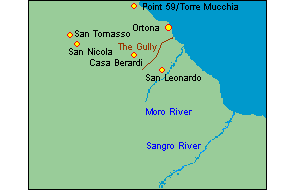
Map of the Italian East Coast campaign, December 1943. From www.canadiansoldiers.com.
At the beginning of December, the Moro River in eastern Italy was an essential line for the Allies to breach. If they could push north across the Moro and capture another 25 kilometres of territory to the north, then the German defences would be beaten and the Allies would be able to push west to take Rome. British, Canadian, Indian and New Zealand troops were deployed. The 48th Highlanders arrived in the area on the night of December 6-7 and dug in overlooking the valley as two Canadian regiments unsuccessfully tried to cross the river. The Highlanders were able to observe the Germans on the high ground across the valley.
The regiment was called to battle in the late afternoon of the 8th and by 2000 hrs the entire unit had crossed the river and navigated the muddy valley to dig in on the western ridge near the town of San Leonardo. By the next afternoon, the Highlanders joined other Canadian regiments in the town and the Germans fell back to their second defensive line, named “The Gully” as it was another ravine that the Germans were using for their defence.
Two of the regiment's companies advanced with The Loyal Edmonton Regiment on December 10, but were forced back by heavy fire. By evening the remaining troops of the regiment occupied the village of La Torre without encountering the enemy. The German line at The Gully was proving impenetrable. On December 18, the largest Allied assault began with Canadian artillery bombing a 900 metre front to a depth of 300 metres. Every five minutes the fire moved forward, 100 metres at a time. Behind this deafening barrage, the 48th Highlanders advanced, only 100 metres behind the explosions. The tactic worked well until the Canadian guns shifted their aim and the German machine guns and Canadian friendly fire devastated the Canadian line. The Highlanders' casualties were light, but the Royal Canadian Regiment was decimated. The Canadians retreated. Ultimately, though, the road to the seaside city of Ortona was in the hands of the Canadians.
The regiment's war was quiet for two or three days and the regimental patrols were determining the German positions. The Highlanders were to capture two villages to the west of Ortona - San Nicola and San Tommaso. On December 24, the regiment started out on a rainy night. They moved in single file on a footpath that hadn't been reconnoitred.
So dark was the night that in order to keep direction each had to hold on to some part of the equipment of the man ahead. Two unguarded houses filled with Germans opening Christmas presents yielded 19 prisoners. By morning of the 24th the battalion was at its objective on the eastern bank of the Riccio, overlooking San Nicola and San Tommaso.
(From Nicholson, Gerald. Official History of the Canadian Army in the Second World War. Volume II: The Canadians in Italy, 1943-1945 (Queen's Printer, Ottawa, ON, 1957.)
The regiment was able to break through the German lines but instead of cutting off the Germans, they had cut themselves off. On Christmas Day, their supporting artillery fired a ring of protection around them and they had to ration their supplies, finding three sheep to add to their food supply. It was a Christmas none of the men would ever forget. Because the weather had been so rainy and the tanks couldn't provide support through the deep mud, it wasn't until December 26 that their predicament ended. On December 31 after a day-long battle, the regiment took both San Nicola and San Tommaso, while other regiments had secured Ortona.
Winter was upon them and the Allied commanders decided that the war had to pause until spring because of the weather. The regiment had been fighting steadily for almost a month and the men were weary. The Canadians remained in the rainy Ortona area for five weeks before heading south. They spent the winter training with reinforcements for the coming spring offensive.
By the beginning of May, 1944, the 48th Highlanders were in Lucera, about 100 kilometres southeast of Ortona, training with the 25th Tank Brigade which had recently arrived from North Africa. At this point, the war was focused on the capture of Rome, for two reasons. Taking Rome would be a further advance north and if enough resources were used, it could force the Germans to send as many reinforcements as possible to Italy, leaving Normandy, where the D-Day landings were planned for the next month, with less protection. South of Rome was the mountain-top town of Cassino which the Americans with the British, the Indians and the New Zealanders had unsuccessfully tried to take three times between January and March. By May, it was decided to take the three mile wide Liri River valley which runs south and west of Cassino to try to surround the Germans. Beyond the valley was what was called the Adolph Hitler Line which was a strategic line in German hands. As with the German lines in Sicily, they were heavily fortified.
On May 4, the regiment moved to the west of Italy, to Caserta, 20 kilometres north of Naples and 70 kilometres south of Cassino. On May 9 at 0130 hrs the regiment trained by crossing a river and at 0815 hrs the cease fire was given and the men returned to camp. Training continued until May 14, when the regiment boarded trucks in the afternoon and headed to Mignano, 15 kilometres from Cassino. They travelled through the night and arrived at 0630 hrs on the 15th. After a rest, they moved to cross the Gari River in the late afternoon and by nightfall had reached their objective and dug in for the night. On the 16th they moved to 20 kilometres north of Cassino, within two kilometres of the Liri River. In the evening they were ordered forward and began battle in the river valley the next day. The Germans used the tall grain to hide their foxholes and the Canadian suffered the loss of many of their tanks. The regiment continued to move forward along the river as the Germans slowly pulled back.
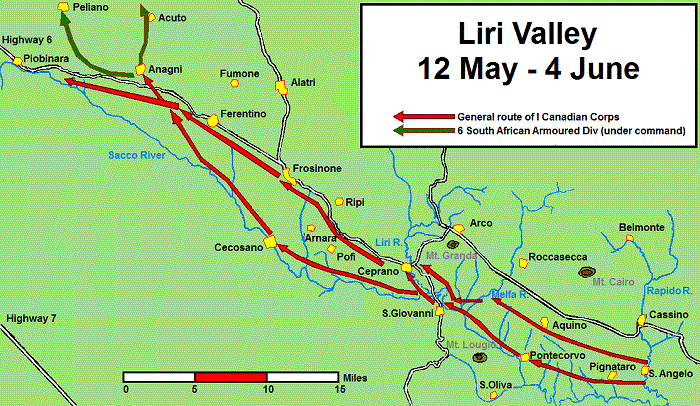
Map of the Liri Valley offensive. The Adolph Hitler Line ran between Aquino and Pontecorvo. From www.canadiansoldiers.com.
On May 21, the 48th Highlanders received orders that the regiment was to break through the Adolph Hitler Line, establish a bridgehead and when relieved by the Royal Canadian Regiment, to continue forward. The regiment's commanders had concerns that the tank support wasn't as complete as they would have liked.
The next day, the battle started at 1030 hrs and many tanks were destroyed by land mines. The regiment crossed the Adolph Hitler Line after a slow and bloody push and by evening the Royal Canadian Regiment reinforcement arrived. The next day, May 23, the regiment's B and D companies were sent forward to capture a ridge. B Company suffered heavy losses. “A” Company followed behind and it was decided not to move forward without proper tank support. The Hastings and Prince Edward Regiment moved ahead of the 48th and closed the gap, ending the battle. That day was the worst for Canadian casualties in the Italian campaign. Fifteen men of the 48th Highlanders were killed that day, including Don. His loss was felt strongly by the regiment. He had been a stalwart veteran of the Highlanders, having been active in most of their battles.

Don's grave, Cassino War Cemetery. From the Canadian Virtual War Memorial.
Don is buried in the Cassino War Cemetery. His youngest brother William had been invalided home in February 1944.. His brother Albert was wounded in the Netherlands in October 1944 and survived the war. Their father George died in July 1952 and Cassie followed him in April 1954. Albert was still living at 56 Wallington Avenue in 1969.