
Documenting the WWII Fallen of Toronto's Elementary Schools
William Craig McNeill
(Brother of Andrew McNeill)

Craig McNeill was born in Toronto on July 25, 1916. His father Hugh McNeill had been born in 1889 in Whiteinch, a neighbourhood of Glasgow, Scotland to Irish parents. He came to Canada in March 1912 to be a grocer, but along with his brother Andrew, the pair soon became waiters to make a living. Two more of their brothers, Walter and John, eventually moved to Toronto. Hugh met Margaret Carter, a woman three years his junior who was born in Old Cumnock, Scotland and who came to Canada as a domestic servant in the same year as Hugh. The couple married on September 22, 1915 and they had a second son, Andrew (“Andy”) who was born on June 1, 1918. In 1919, Hugh became the caretaker of a medical building which had formally been a large house at 147 Bloor Street West, east of Avenue Road and the position came with an apartment in the building.
The family had a vacation to visit family in Scotland in the summer of 1921 returning just before Craig entered his first year at Wellesley School. Craig finished Grade 8 at Wellesley in 1930 and that year the family moved to Robina Avenue because Hugh became the manager of a Dominion grocery store on St. Clair Avenue. Craig started Grade 9 at Oakwood Collegiate in September and Hugh bought 613 Christie Street just north of the Wychwood Barns. Craig left Oakwood after completing three years and attended a business college where he took Bookkeeping, Accounting and Typing. By 1937, he was a clerk for Metro Transport, a trucking company that was on Sorauren Avenue.
In 1938, Hugh opened a grocery store at 161 Eglinton Avenue East and the family lived above the store. They rented out their Christie Street house. Craig had a girlfriend, Aileen Mary Cruikshank, who lived on Kelway Boulevard near Avenue Road and Eglinton. Her accountant father had died in 1937 and she lived with her mother and sister. She was a clerk for an insurance company. The couple married on May 24, 1941 and they rented an apartment in 19 Woburn Avenue, near Yonge and Lawrence. Craig and his brother Andy had been working at De Havilland aircraft since 1940 as aircraft joiners, paid $200 a month.
Andy joined the RCAF in February 1942 and Craig enlisted in the army on June 1. On June 12 he started his basic training in Peterborough and a month later became a reinforcement in The Irish Regiment of Canada which at the time was performing local protection. On August 12, the unit moved to Camp Borden near Barrie but at the end of September, Craig was assigned to the Canadian Signal Training Centre in Kingston. There he was taught battlefield communications systems. Likely Craig's clerical skills were the reason for the attachment and he eventually became a qualified regimental infantry signaller.
Friday evening December 4 was Andy's wedding day at Deer Park church in Toronto. On December 12, Craig had at least ten days' leave and then on January 29, 1943 he started his two week embarkation leave. He returned to Kingston on March 9 when he shipped to Britain two days later, docking on March 17. With Craig's departure, Aileen moved to an apartment in a house on Berwick Avenue, near Eglinton and Yonge. Craig had $20 per month sent to her from his army pay.
When Craig arrived in England, he was part of the Canadian Reinforcement Unit, allotted to The Irish Regiment of Canada. He became an acting lance corporal in April and was assigned to the Canadian Military Headquarters in the Signal Reinforcement Unit. He took a course at the headquarters and in June he became an acting corporal. He had a privilege leave from July 12 to the 21st and possibly visited his Scottish relatives. His only disciplinary infraction was on September 14 when he committed two offences under section 40 of the Army Act which stated that a soldier “is guilty of any act, conduct, disorder, or neglect, to the prejudice of good order and military discipline.” This appears to be a catch-all for less serious offences and could be something as mundane as possessing a comrade's property where there was no evidence of theft. Craig was severely reprimanded for his transgression.
Now a pilot with the RCAF, Andy arrived in Britain on October 16. Craig started a seven day leave on October 25 and hopefully the brothers met up in Bournemouth, where Andy was stationed at the time.
On December 15, Craig joined an Officer Cadet Training Unit (OCTU) where he would be trained to be an officer. He attended the Pre-Officer Cadet Training Unit at Wrotham Park, Herffordshire, north of London and on January 12, 1944 he joined a specialist OCTU at Aldershot and was assigned to The Algonquin Regiment, a Canadian infantry regiment. He was moved again to the Canadian Reinforcement Unit on May 10 in the preparations for D-Day, which was June 6. From June 23 to October 5, Craig trained at the OCTU. He was promoted to Lieutenant on October 19. This was bittersweet. News reached Craig days after that Andy had gone missing piloting a Lancaster bomber to Duisberg on October 14.
On November 10, Craig embarked for Europe, arriving the next day. On November 28, he was a reinforcement for The Queen's Own Cameron Highlanders of Canada, a Winnipeg infantry unit. It had been on Green Beach at Dieppe in August 1942 and had suffered extremely high casualties. In the ensuing two years, the unit had been rebuilt and had arrived in France again on July 7. The unit had fought at the Falaise Gap in France and had recently battled for the Scheldt estuary.
When Craig arrived, the unit was dug-in in the town of Mook en Middelaar in the southern Netherlands, three kilometres from the German border. The rainy weather had rendered the ground muddy. Craig was assigned as one of three lieutenants in “B” Company and on November 29, the rain had caused the company, positioned on low land, to be surrounded by up to three feet of water. Supper had to be sent to the troops via two assault boats. That evening the company's fighting patrol was to destroy an enemy machine gun nest and secure prisoners of war. Twelve of the enemy escaped under fire from their own machine guns. Craig quickly discovered that the fighting around Mook was on a house by house basis.
The regiment stood down for several days, billeted in the nearby town of Cuijk. They received Christmas parcels from Canada, spruced up their kit and underwent special exercises with tanks. On December 8, the regiment relocated to Bisselt, a kilometre west of Mook, to take over from The Black Watch. A week later, the unit moved another four kilometres northwest to Groesbeek where it experienced light mortar fire and daily rain. Below is a report by Craig in the regiment's December war diary. He was leading eight men on a patrol.

On Christmas Eve, the regiment fell back to Mook. Keeping with military tradition, the officers served the men Christmas dinner. The regimental war diary noted: “Dinner was a huge success and enjoyed by all who attended.” Training continued but the regiment had a sports day on December 30 where Craig was the officer in charge of the balance test.
The New Year brought increased activity in the skies above them as Allied fighters attacked enemy planes. On January 2, 1945, twelve shells dropped in “B” Company's area. Fortunately no one was hurt, but windows were broken. By the middle of the month, the regiment was back patrolling the Mook area. V1 & V2 bombs whizzed overhead in the direction of Belgium and England. On January 24, the unit moved to Zevendal, a kilometre west of Mook, to relieve The South Saskatchewan Regiment.
Craig became involved with the regimental swimming team, which would compete against other teams in the battalion. On January 26, and a week later, he and two other lieutenants took a number of men to the swimming pool in Nijmegen, 15 kilometres away, for practices. On January 31, the regiment returned to Mook to relieve The South Saskatchewan Regiment again..

Map of Dutch and German towns where The Queen's Own Cameron Highlanders were posted or fought during the time Craig was with them.
On January 28, the Battle of the Bulge was over. It was the last major German offensive campaign of the war, which took place in the Ardennes region between Belgium and Luxembourg. In February, the enemy action against the Camerons increased. Craig's “B” Company encountered machine gun fire, light shelling and enemy patrols with more frequency. On February 8, Operation Veritable began, an Allied pincer advance to push into Germany. The Canadians, on the northern flank, used amphibious vehicles to clear German positions in the flooded Rhine plain. The Camerons were not involved with the initial advance and on February 14, the regiment moved to Nijmegen for rest.
Three days later the Camerons relocated to Bedburg-Hau, Germany, 20 kilometres from Nijmegen. The men were extra vigilant about the civilians, whom they could not trust. The unit advanced five kilometres southeast, to Kalkar, Germany where “B” Company had two casualties due to mortaring on the 20th. That afternoon the company took a farm which they occupied without opposition.
On February 25, the men had a rest in Bedburg-Hau and wrote letters before Operation Blockbuster, where the Canadians would complete Operation Veritable which had stagnated. On the 26th, the Camerons climbed onto Kangaroo armoured vehicles at 0430hrs. Some of the Kangaroos bogged down in the mud but “B” Company was to attack the village of Louisendorf, four kilometres to the west of Kalkar. They saw hard fighting that day but they took the village and 90 prisoners of war. They rested on the 28th and the war diary notes: “Personnel very busy cooking up conquered chicken dinners.”
The enemy was defending the Hochwald Gap in the Hochwald Forest. On March 1, the regiment marched at 0400 hrs and the advance was slow due to the destruction of the roads. “B” Company occupied an area on the southern periphery of the forest. The next day there was a limited advance into the forest. On March 3, the attack was launched at 0400hrs after a thirty minute artillery barrage. The Camerons faced intense machine gun, mortar and shellfire. “B” Company reported six casualties after attacking houses and forest area under heavy artillery fire. The regiment was relived the next day by The Black Watch and rested on the 5th. In the early hours of March 6, the regiment moved forward into battle at 0650 hrs under a heavy artillery barrage. “B” Company advanced 500 yards but were forced to ground by enemy fire. The commanding officer realized that the objective would not be reached and the last of the troops were withdrawn by 1300hrs.
On March 9, the regiment was in the town of Xanten where it was deployed along the northwest sector of the town. The regiment moved to take over the positions of The Calgary Highlanders. On March 11, “B” Company encountered a Dr. Otto Muller who was living in the buildings occupied by the company. He was interrogated and it was concluded that he was not an enemy agent.
It was relatively quiet on March 12 when the regiment moved 30 kilometres northwest to Rindern, north of Kleve. Billets were cleaned up and the men relaxed and tidied their kits. The next movement was to clear the enemy in nearby territory on March 18. The regiment set out at 0700hrs across minefields and flooded land and achieved its new position by noon as the enemy had fled. Unit training continued, including the practice of river crossings in assault boats, in anticipation of crossing the Rhine, which was first crossed by units of the British and the American armies on March 23. The unit continued training “with flamethrowers and route marches to toughen up for pending [operations].”
The Camerons crossed the Rhine without incident on March 28 over a rebuilt bridge. The men camped east of the village of Praest. The unit stood by patiently until the British completed their operations ahead of them. At 1500hrs the men moved forward and took up their positions. A few shells were dropped on the main road, but otherwise it was quiet. That night Craig's “B” Company captured 64 POWs. The regiment experienced significant mortar fire on March 30 as they pushed north, back into the Netherlands. The regiment sustained fourteen casualties of which two died.
On March 31, the Camerons were to be part of an advance to clear five kilometres north to the village of Veldhunten. “B” Company was part of the second phase to clear the village. At 1500hrs Craig and his company began their advance but only proceeded 600 yards (550 metres) “when they were pinned down by [machine gun] fire. Due to condition of the ground, tanks could not manoeuvre to extricate them.” “B” and “D” Companies gained some ground, but heavy crossfire and low ammunition pulled them back a few yards to regroup. The war diary noted “It was about the stiffest resistance encountered this side of the [Right] Rhine.”
The Camerons moved north, sometimes over 30 kilometres a day, as the Canadians were tasked to push towards the North Sea. When they moved in convoys, the “people in all centres through which we passed turned out en masse and gave the boys a rousing welcome. Wherever a halt occurred the familar (sic) query, 'Any chocolate or Cigaretten' followed the first formal greeting.” The Dutch had just endured the “Hunger Winter,” where any food was requisitioned for the German troops and the Dutch were starving, some reduced to eating tulip bulbs. The Canadian liberation was a jubilant relief.
The unit camped in the town of Almen, located a kilometre south of the Twente Canal on April 4, the day The Lincoln and Welland Regiment crossed the canal after a three day battle. The Camerons were to cross the canal on April 6, and “B” Company at 1400hrs was tasked to make a “quick crossing and make contact with the enemy” to discover if the enemy was still defending the canal. The men were under heavy shelling and mortar fire. “B” Company's commander, Major Hugh Philip Falloon, who was on his way to report with “C” Company's commander, was seriously injured by enemy mortars while crossing the canal. On April 7, while stationed near Holten, “B” Company cleared a woodland of enemy, killing four and taking 36 PoWs.
On April 10, the regiment was transported all night 50 kilometres north to the city of Hoogeveen and later that day they moved at all speed to the area of Beilen, a city 20 kilometres further north. The companies formed a bridgehead over a canal southeast of the city. They crossed the canal and by 1900hrs they were north of the city and moving quickly towards Hijken, a town a few kilometres farther north. On April 13, the unit rested in the town and the men were able to clean up. At midnight the regiment was put on two hours' notice to move. The next plan was to launch an attack on the city of Groningen, 45 kilometres north. The men were transported to a concentration area 10 kilometres south of the city and crossed the starting line at 1525hrs on April 14. “A” and “B” Companies cleared the northern half of the town of Haren. Later the next day the unit rested in Helpman on the outskirts of Groningen.
On the morning of April 16, the battalion moved at 1040hrs to pass through the positions of Les Fusiliers Mont-Royal. By noon, “A” and “B” Companies were well in advance. At approximately 1300hrs,
“'B' [Company] reported enemy holding [bridgehead]... and requested [artillery] mortar [assistance]. The [bridge] had a lifting device on the centre span and the germans had raised this portion of the [bridge]. Two [civilians] approached Capt J H Ross of 'B' [Company] and offered them their services in lowering this span. In order to do so however it was necessary to cross the canal on a very narrow cat walk constructed from a ladder. The area was being swept by automatic [weapons] but a crossing was effected and the [civilians] managed to [move] the mechanism and the [bridge] was soon available for use. Lt W C McNeill and one [civilian] helper were wounded while performing this feat and but for their coolness under [heavy] fire the success of the [operation] would have been greatly retarded. Once the [bridge] was in [position] and [troops] could be moved to the EAST bank, the german resistance collapsed and 'B' [company] had a firm [bridgehead] across the canal.”
Craig's heroic actions at the Van Starkenborgh Canal had aided his company's success. He had been shot in the abdomen and was quickly taken for medical help. He was operated on at 1900hrs and his wound was found to be severe. On the 23rd he was moved to the 13 Canadian Field Dressing Station in Groningen and had a second operation because his internal wound reopened. He had a third operation on May 4 and the surgeon encountered a “VERY difficult dissection.” Craig's medical record states that he died at 2355hrs on May 9, although his official date of death is May 10. The war in Europe ended on May 8. Craig was buried in the Holten Canadian War Cemetery.
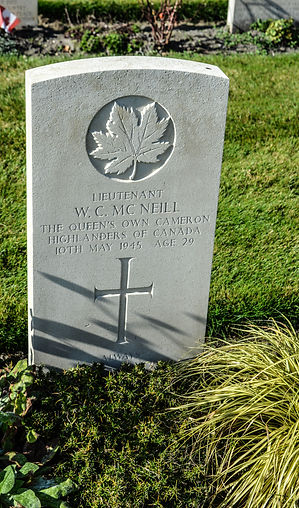
Craig's grave, Holten Canadian War Cemetery. Photo: Wouter van Dijken.
After Craig's death, Aileen moved back in with her mother on Kelway Boulevard. She'd been working as a stenographer at The Royal York Hotel. The two women moved to Vancouver, British Columbia a year later. Hugh and Margaret, who had now lost both their children in the war, continued running their grocery store until the early 1950s when Hugh went back to work for Dominion stores. They returned to their Christie Street house and were still there until the late 1960s.
In November 1945 Aileen wrote in a letter to the Department of National Defence: “My husband was proud of the Army and his part in it and I shall always be too.”