
Documenting the WWII Fallen of Toronto's Elementary Schools
William George Lister

William Lister was born on October 17, 1916. The day before his birth, his father William Sr landed in his home town of Liverpool, England as part of the Canadian army in World War I. Within the next year, he had been wounded in the right leg, patched up and sent back to the front in France. Born in 1887, William Sr had immigrated to Toronto before the war. William Jr's mother Mary Dowling had also been born in Liverpool that same year to Irish parents and came to Toronto in 1914 to be a waitress. Whether the couple knew each other in Liverpool is unknown but if they met in Toronto, their shared background brought them together. They married on June 24, 1915 in Toronto.
Mary was living at 59 Elmer Avenue in the Beach neighbourhood during the war and once William Sr returned from overseas, they bought 270 Gledhill Avenue, just across the street from the main entrance of today's D A Morrison School. William Sr was a stonecutter and appears to have had an extended family in Toronto as there were several Lister men in Toronto who were also stonecutters.
William Jr was the oldest of six children. Edna, Evelyn, Stanley, James and John were born by the early 1930s. William attended Danforth Park, arriving there in the first or second year after it opened. He graduated in the Class of 1930 and completed Grade 9 at East York High School. He transferred to Danforth Tech, specializing in the printing program and graduated in 1934. He enjoyed reading and loved to swim and skate. William could play any position on a hockey team when given the opportunity. He eventually became a pipe smoker. In 1935, he went to work for a year on a farm in Stroud, Ontario, near Barrie. Back in Toronto, he landed a job as a printer at the Globe Envelope Company which was located on Carlaw Avenue near Dundas.
William Sr, being a veteran, became an active member of the Woodbine Heights Legion, and was a bartender and steward there in the 1940s. The Woodbine Heights Legion branch opened in 1926 and at the time was located at Barker and Glebemount Avenues. After WWI, legion halls proliferated all across the country, providing a social club for military men and veterans in every neighbourhood. When World War II started, William Jr joined the Dufferin and Haldimand Rifles of Canada which was a reserve unit based in southwestern Ontario. (It should be noted that Brigadier Oliver Milton Martin commanded the force in the Niagara region. He was the principal of Danforth Park School from 1937 to 1940 and was the commander of the Dufferin and Haldimand Rifles upon its formation in 1936.) William would have spent most weekends with the regiment and he also became a member of his father's legion branch.
The Dufferin and Haldimand Rifles mobilized in May 1940 and William enlisted full time on July 28, stating his reason for joining was because he “wanted a change.” The regiment was based in Brantford and that's where William trained until February 6, 1941 when he was given two weeks' furlough. When he returned on the 19th, the regiment was stationed at Camp Chippawa near Niagara Falls. With the proximity to Toronto, William was able to travel back home on his days off to see his family and his girlfriend Lillias (“Lillie”) Brown Campbell. She lived with her family on Woodbine Avenue near Gerrard and worked at the Colgate plant that was on Carlaw Avenue across the street from Globe Envelopes, where William worked.
Like many soldiers, he had a couple of infractions for being AWOL – he was four days late getting back to camp in late April and a few hours late on November 11. His punishment both times was to lose a few days' pay. In late winter 1942 the regiment was given word that it would soon be moving to British Columbia. In the middle of March, William was given two weeks' furlough. He and Lillie married on March 16 and had a nine day honeymoon. On March 26, William kissed Lillie good-bye and joined the regiment and Brigadier Martin for a week-long train ride to the west coast. The regiment was stationed in Nanaimo on Vancouver Island, tasked with coastal defence.

William in uniform, date unknown. From The Canadian Virtual War Memorial.
On April 27, 1942, William gained a promotion to acting lance corporal. The moist atmosphere of Vancouver Island caused his right knee to give him some grief and he spent a week in hospital in May with bursitis. Lillie moved to Nanaimo by the end of May and rented a room in a house. On June 6 William became a lance corporal, but being a guard in British Columbia wasn't the life change he was seeking. He applied for a transfer and by August 5, 1942 he joined a reinforcement unit in Sussex, New Brunswick. Lillie moved back to her family's house on Woodbine Avenue. On September 27 William was demoted to private because of the transfer. He embarked at Halifax on September 29 and arrived in Britain on October 7. On the 19th of October he joined the Royal Hamilton Light Infantry.
The HRLI, nicknamed The Rileys, had seen action at the disastrous Dieppe Raid on August 19. Only 102 soldiers of the 582 who landed were not among the casualties or prisoners of war. The survivors had suffered tremendous psychological distress at the loss of so many of their comrades. The unit needed to be rebuilt and so commenced almost two years of training, mostly at Aldershot, the main British army camp. The training would also have included war games and a lot of long distance marching – everything to prepare the men for the coming invasion of France.
On March 29, 1943, William suffered a head injury and was admitted to hospital. He spent two months in hospital and another six weeks in a convalescent hospital. After his release he had two weeks' leave and re-joined the Rileys as good as new on August 11.
In September, William successfully completed rifle, Bren gun, grenade and anti-tank gun tests. He was appointed acting lance corporal again but was demoted on January 5, 1944 for being AWOL for almost seven days. He was made an acting lance corporal once more on January 22. The next month he scored a perfect mark on a mapping course. In April he was promoted to acting corporal but at his own request, he reverted again to a private on May 24.
The D-Day landings in France were June 6, 1944. Perhaps because of the front line position of the Rileys at Dieppe, the unit didn't embark for France until July 4, landing the next day. All the fighting had moved about 15 kilometres inland, around the town of Caen. The Germans were holding on to the area with a tenacious grip.
Once the town of Caen had been captured on July 19, Operation SPRING was hatched to take the Verrières Ridge 8 kilometres south of Caen. The ridge prevented a direct advance by the Allies south to Falaise. Strong counter-attacks had prevented an Allied advance and by July 24, the Germans had determined that the ridge was the intended target so they had 480 tanks, 500 field guns and four extra infantry battalions moved to the area.
On July 25, 1944, the Royal Hamilton Light Infantry finally joined the Battle of Normandy and advanced on to Verrières Ridge. The regiment was soon fighting a vicious battle in virtual isolation after the battalions to its right were driven back. Despite repeated counter-attacks, by 0530 hrs the Rileys held firm in the village of Verrières until reinforced by a squadron of the British 1st Royal Tank Regiment. The fight cost the Rileys 50 dead and 126 wounded but Operation SPRING was a success by July 27. The Rileys were the only regiment to take and hold its objective.

Allied soldier with Bren gun, 1944. The Imperial War Museum collection.
In the early hours of August 1, William was on a fighting patrol with seven other men, commanded by a lieutenant. The enemy threw grenades and the Rileys answered with Bren guns and grenades of their own. An enemy grenade landed at the lieutenant's feet and wounded his legs, but he was still able to give the men orders. Two of the men were hit with machine gun fire. The lieutenant instructed one of the uninjured to go and get help while William and another man, Lance Corporal Tapp, dragged the injured back 55 metres into a wheat field. The enemy sent out a search party of about 20 men who initially missed spotting the Canadian patrol. The lieutenant ordered William and Tapp to get away and try to find help. Tapp stated: “We started back and after about 10 minutes we heard our Bren and rifles firing and the enemy answering.”
William and Tapp knew that the patrol had been surrounded and it was later determined that one of the men died and the remaining four were taken prisoner. Later that day William had the bitter-sweet promotion to acting corporal.
The Canadians conceived Operation TOTALIZE to prevent a German retreat through a narrow corridor called the Falaise Gap near the town of Falaise. The Germans were surrounded with the exception of the escape route. The operation was completed with the breaking through of the German front on August 9. The Allies inched farther south with the ultimate goal of capturing the town of Falaise itself. The Rileys were part of a reconnaissance advance on the town of Clair Tizon and were to lead the march with the objective of capturing the hamlet of Barbery. The regiment arrived at the start line at Bretteville-sur-Laise late on August 11 and it began advancing at 0730 hrs on August 12 with tank support.
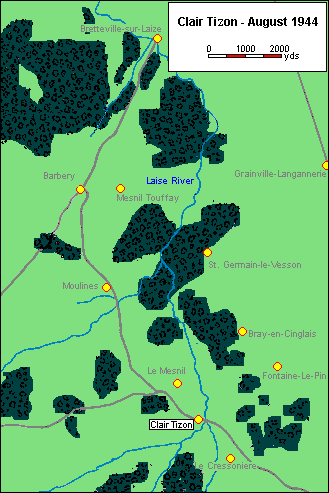
Map of the advance towards Clair Tizon, August 11/12, 1944. From www.canadiansoldiers.com.
The RHLI passed Barbery, a hamlet of a few houses which was the half-way point. Nothing stirred there; not a person or farm animal...The men waded through the unharvested wheat on each side of the road. Major Joe Pigott's C Company was forward left and B under "Huck" Welch to the right, with Jack Halladay's A Company behind it. Major Dunc Kennedy commanded D, behind Pigott. The field narrowed about a thousand yards beyond Barbery where woods closed in on each side of the road. The men were sodden with sweat and chaff and pollen clung to their trousers as they walked resolutely through the woods. A breeze rustled the aspen and poplar, their whispers punctuated by the odd clink of equipment and the whine and slap of the Shermans coming up behind them. C Company was the first to come under fire from machine guns in a copse to the left. Then all the rifle companies were enveloped in a storm of bullets and shrapnel. Lyle Doering, the battalion Intelligence Officer, later recorded it as "the most intense mortaring and shelling the unit ever witnessed."
From the German point of view it was essential to hold the Falaise pocket open for a few more days..."They were fanatical devils and we started to have casualties right away," Pigott recalled later. "There was hand-to-hand fighting as these fellows came running out of their slits, firing rifles and grenades. The opposition was so bitter that I determined in my own mind that we were going to have to limit our objective."
...The companies had advanced 600 yards beyond Barbery when Pigott gave his order to stop and consolidate. The men dug in. A private in B Company paused from his labour long enough to glance toward the woods. "Sir, are those our tanks over there?" he yelled to his commander. "Of course they are," Welch replied, not bothering to look up. "Jesus, they sure don't look like it to me." Welch straightened. Trundling towards his company was a Tiger tank. "No, they sure don't," he said, and every man dropped into his half-scraped hole. The Shermans were no match for the massive Tiger, with its 88mm gun and the Tiger concentrated on knocking them out, while a couple of Panthers which had now joined it sprayed the RHLI with machine-gun fire. The German tanks were all out of PIAT range and German panzer grenadier infantry stopped the RHLI from closing with them.
(From Greenhous, Brereton. Semper Paratus: The History of The Royal Hamilton Light Infantry (Wentworth Regiment) 1862-1977, W.L. Griffin Ltd, Hamilton, ON, 1977, pp.259-260.)

William's grave, Bretteville-sur-Laize Canadian War Cemetery. Photo: Shirley Tort, www.findagrave.com.
It was during this battle that William was killed along with 25 other Riley men. He is buried in the Bretteville-sur-Laize Canadian War Cemetery, the resting place of other Danforth Park alumni: George Ford who was killed in that region the day before, Eric Garbutt, John Tanner and Donald Robertson. During the war the Lister family moved to 203 Cosburn Avenue near Donlands. When William Sr died in 1963, he and Mary were living at East York Acres. Mary passed away in 1977. Lillie continued working at Colgate and lived for almost 25 years at 199 Pape Avenue. By 1969, she had not remarried.