
Documenting the WWII Fallen of Toronto's Elementary Schools
Peter James Lim

(Not mentioned on Wellesley's Honour Roll. Is commemorated on Danforth Tech's 2023 additional Honour Roll plaque.)
Pete Lim's mother Margaret Hunter was born in Edinburgh, Scotland in 1895, the daughter of a lithographer. She became a waitress and immigrated to Canada in April 1921, arriving with $50 in her pocket. Her address was the YWCA hostel in Toronto where she stayed until she found work. Before the days of air conditioning, Toronto Island and other lakefront areas provided a summer respite from the city heat and many people either had cottages there or stayed in one of the several hotels on the Island which opened for the summer season. Margaret quickly found work at the Pierson Hotel which was located near today's Centre Island pier. It was a grand three storey building that looked out on the lake to the south. Margaret mainly waited tables in the waffle shop and snack bar and lived in the staff accommodations which were several smaller buildings at the rear of the hotel.

The hotel's chef was Lim York Foon, known as Harry Lim. He was the same age as Margaret. Born in Canton, China, he was taken from his home when he was an infant, never knowing his parents. He was a Presbyterian which indicates that he likely had been in the care of missionaries. The history of Chinese immigration to Canada before the 1950s is a racist one. In 1885 a head tax of $50 was levied on any Chinese coming to Canada, making it the only ethnic group that had to pay a tax to enter the country. In 1900, the tax was doubled to $100. The cost of bringing a wife or dependent relatives was prohibitive and most Chinese in Canada lived as bachelors, establishing grocery stores and laundries. Chinese cooks were in the majority in restaurants, hotels and affluent homes. Harry had arrived in British Columbia in 1911 and had come east to work in Toronto.
When the hotel closed for the winter, Harry and Margaret moved to University Avenue, renting rooms in houses close to each other and they continued to work as a chef and a waitress. University Avenue until the 1930s was a tree lined residential boulevard that stopped at Queen Street. Harry and Margaret lived in the block just north of Dundas Street on the west side. Margaret stayed at 128 and Harry was living at 124 at the Chinese Christian Association. They married on February 28, 1922 and Pete was born on University Avenue on May 23. The couple had a daughter, Mary Margaret, two years later. After Mary's birth Margaret took her children to Scotland to live for two years, likely staying with her parents in Edinburgh. Harry often worked as a chef in private residences and his position at the time may have forced him to live in, with no accommodations for a family.

University Avenue looking north from Dundas, early 1900s. City of Toronto Archives.

Peter's C. I. 44 certificate, 1924. All Chinese or those of Chinese descent in Canada had to register with the Canadian government after the Chinese Exclusion Act came into effect in 1923. Provided by Catherine Clement, Chinese Canadian Military Museum Society.
In the meantime, due to his marriage to Margaret, Harry was naturalized as a British subject on July 18, 1925.
Margaret and the children returned in 1926 and the next year Margaret gave birth to Francis Harry, who was known as Frank. In 1929 Pete had scarlet fever and a tonsillectomy. He also contracted mumps at some point in his childhood. In May 1930, Margaret gave birth to a premature son, Roy, who unfortunately died the same day. At this time, the family was living on Dundas Street West near Dufferin. On Pete's application for the RCAF, he claimed Wellesley as his only Toronto elementary school. However, if the family was living near Dundas and Dufferin, Pete probably began his school career at Brock Public School.
In 1931, Harry was hired as the chef in the home of H. A. Brown, who was the vice president and general manager of General Motors in Oshawa. By 1932 the Lims rented 16 Ritson Road North and the children attended Ritson Road School. In October 1934, the school had its annual school fair and Pete won an art award in his class. His sister Mary won a writing award. Pete delivered THE TORONTO STAR to make some pocket money.
Mr. Brown appears to have left Oshawa in 1936 and whether he transferred to another GM plant or he retired is unknown. The Lims returned to Toronto and the Lim children attended Wellesley. Pete would only have studied Grade 8 there. In 1937 he attended Central Tech for a year and for Grade 10 he was at Danforth Tech, leaving in 1939. Pete liked bowling and baseball and he collected stamps. He was able to speak colloquial Chinese thanks to his father.
Pete's transfer to Danforth was due to the Lims moving from downtown to the Playter Estates area near Broadview and Danforth and Harry was the chef for the family of the president of an investment brokerage who lived nearby in Todmorden. By 1943 the Lims moved to an apartment above a store at 119A Danforth Avenue near Broadview and Harry continued to be a cook.
Pete was interested in engines and in becoming an electrician. He entered an electrical apprenticeship and served three months. In March 1940 he landed a job at Reid-Cameron, an electrical appliance manufacturer on Richmond Street West and was an assembler there. Pete began his paperwork for the RCAF in August 1941, aspiring to be an engine mechanic. The previous month he'd left his job and started the Aero Engine course at Central Tech, which he finished that November. When he finally enlisted on January 8, 1942, he had to provide his father's naturalization papers to the RCAF. Noted on his interview report was “Very slight trace of Oriental in appearance.” Another racist comment on his application was “Never in trouble with police.” This is a comment this writer has never seen on the applications of white RCAF recruits.
The usual path of a Toronto RCAF recruit was to spend several weeks at the manning depot on the Exhibition grounds, going through drills in basic training and kit maintenance. In March, Pete was sent to the Technical Training School in St. Thomas, Ontario. It was located in the converted Ontario Psychiatric Hospital complex and could train over 2000 students at a time. The courses were usually six months long and offered programs for aircraft mechanics, electricians and fabric and sheet metal workers. Since Pete had taken the areo engine course at Central Tech, he was fast-tracked and completed the course by the beginning of June.

RCAF Trainees assembled on the parade ground at No. 1 Technical Training School, St. Thomas, ca. 1940. From The Elgin County Archives.
On June 3, he reported to the aerodrome at North Sydney, Nova Scotia on Cape Breton Island. Today it is JA Douglas McCurdy Sydney airport. When Pete arrived, it had three 1,500 metre (5,000 foot) runways, to accommodate the largest airplanes. The airfield was used to house an RCAF squadron which performed anti-submarine duty and was also a staging field for Ferry Command, which flew North American built aircraft to squadrons in Britain. As a member of the mechanics' crew, Pete would have performed repairs and maintenance for the engines of any of the planes at the airport.
On September 17, Pete was given leave until October 1 and he likely returned to Toronto. On December 18, he was transferred to RCAF Aerodrome – Dartmouth, today's CFB Shearwater, near Halifax. This base also housed anti-submarine squadrons. He was finally attached to No. 117 Squadron at Dartmouth on February 22, 1943. The unit flew Consolidated Canso seaplanes that undertook anti-submarine patrols.

Consolidated Canso seaplane. From www.1000aircraftphotos.com, Ron Dupas collection.
Pete put in for a transfer to aircrew on April 29. He continued as a mechanic until his leave on July 14 and on July 28 he was sent to the manning depot in Lachine, Quebec but returned to the depot in Toronto on August 6. He was subjected to physical tests and at 5'3”, he was considered “too short for pilot” but recommended as a navigator or air gunner. It was also found that he had above average night vision. He entered the typical path of RCAF navigator candidates in the British Commonwealth Air Training Plan. First, at least four weeks at Initial Training School (for Pete, it was at Victoriaville, Quebec on September 4) to learn theoretical subjects like aircraft identification, meteorology and the theory of flight, eight weeks at Air Observer School (at No. 4 school in London, Ontario on November 29), a month at a Bombing and Gunnery School and finally a month at navigation school. When Pete won his navigator's wing on April 21, 1944, he had spent almost 100 hours in the air. He was immediately given his embarkation leave until May 5. The day after, he reported to the Aircrew Graduate Training School in Maitland, Nova Scotia, which provided further training in the duties and responsibilities that went with his new rank of Flying Officer. The men spent three weeks learning survival and evasion techniques that would be useful if they were shot down behind enemy lines. In the paperwork he filled out there, Pete stated that after the war he hoped to be a navigator on a luxury liner.

Pete, an RCAF trainee, likely early 1944 at London, Ontario. (David Hagelaar collection.)
On May 25, Pete shipped out of Halifax and landed safely in Britain on June 2. All RCAF airmen reported to the Personnel Reception Centre in Bournemouth, England where their future postings would be handed out. He was given leave from June 10 to 16 and during his time in Britain, he visited his grandparents and family in Edinburgh.
Pete reported to No. 62 Operational Training Unit (OTU) in Ouston, near Newcastle in England's northeast. It trained radar operators for night fighter planes in Anson and Oxford aircraft. He proved to be an above average student. When the course ended, he was given leave from October 4 to 16. It may have been around this time when Pete paid £21 for a New Imperial motorcycle so that he could visit his family in Scotland.
On October 17, he began the course at No. 54 OTU in Leeming, about 100 kilometres south of Newcastle. Pete was to be trained on de Havilland Mosquitos for night fighting. He teamed up with pilot John Henry Skelly who was a month older than Pete. Skelly was born in Edmonton to an Irish father and a Dutch mother, but grew up in British Columbia. He had acquired the nickname “Skeeter” or “Skeets” for short. Skeets, at 5'4”, just broke the pilot height threshold.

De Havilland Mosquito. From Wikipedia.

Pete beside a Mosquito, likely 1945. (David Hagelaar collection.)
The Mosquito had a wooden frame and two engines and was one of the fastest Allied planes, reaching more than 640 km per hour. It carried a crew of two, a pilot and a navigator, who sat side by side in the cockpit but a passenger could be carried in the plane's bomb bay. Pete and Skeets took their leaves at the same time, likely travelling together. From November 9 to 16 they had a privilege leave and on December 19, they were posted to No. 54 OTU's satellite field at RAF Winfield in the Scottish border region. This was an hour's drive from Edinburgh and some of the holiday season was likely spent with Pete's family.

Pete with relatives on Princes Street, Edinburgh, late December 1944 or early 1945. (David Hagelaar collection.)

Skeets and Pete. Pilot John Henry Skelly and Pete, 1945. Photo: Kit Kennard, Aukland Museum.
The pair had another leave from January 19 to February 12 and they completed their course by March 8. Pete scored 78% in his navigation course. The next day they were given another leave until March 20. Following this, as one of four Mosquito crews, they reported to RCAF No. 409 Squadron which was located in Vendeville, France, near the Belgian border. At this point, the war was nearing its end, with the crossing of the Rhine on March 22 and the subsequent advance into Germany.
The 409 was a night fighter squadron which had been in France since August 1944, one of the first Allied squadrons to be based in Europe after D-Day and had been at Vendeville since the previous October. The squadron had an intramural softball series. Pete, who had brought a baseball glove from Canada, would have been a participant. He also continued to collect stamps.
The pair's first operational night patrol was on April 19, the day the squadron relocated to Rheine, Germany where the men would be sleeping under canvas. It was the first Allied night fighter squadron to be based in Germany. The airfield was littered with burnt out and damaged German aircraft. The squadron's records stated: “All personnel have their fire arms serviceable and handy and ready to meet any unfriendly neighbor.” The pair took off at 1940hrs and returned at 2315hrs after an uneventful patrol.
On the 21st, a number of Stirling bombers landed at the field. Two landed on their bellies and caught fire but were quickly extinguished and no one was hurt. Numerous Dakota aircraft were landing at the airfield to evacuate hundreds of liberated prisoners of war. All personnel were confined to the airfield to prevent fraternization but recreational activities had been quickly organized including a cinema, volleyball courts, baseball diamonds and horseshoe pits.
April 23 proved to be more exciting, when the pair went out on patrol at 2100hrs and destroyed two Ju. 52 transport aircraft. As the squadron record noted, they had “started their tour with a bang.” They returned safely at 2355hrs. Their patrols on April 26 and May 1 proved uneventful. As VE Day approached, the squadron flew no patrols and remained on standby. When VE Day was announced on May 8, the squadron celebrated with a huge bonfire and a meal of fresh pork. The airfield continued to be used to evacuate POWs but the squadron was pulled back to Gilze-Rijen in the southern Netherlands on May 16. The unit was back living in barracks with plenty of hot water.
Keeping discipline was the main task while the men patiently awaited word of a return to Britain. The weather at the end of May was very rainy, which grounded the Mosquitos for any routine flights. Pete and Skeets had a ten day leave from May 31 to June 9 and likely visited Brussels, as most of the squadron leaves were taken there at this time. However, since Skeets had a Dutch mother, he may have sought out her relatives.

L-R: Skeets Skelly, two unknown pilots & Pete on leave, likely in Brussels, 1945. (David Hagelaar collection.)

Mosquitos of No. 409 Squadron. From www.themilitarymuseums.ca.
When the pair returned, the squadron was preparing to relocate again. On June 10, the Mosquitos were flown to Twente, approximately 200 kilometres to the northeast and 15 kilometres from the German border. Cross country flights would recommence on June 15. Two crews would be on duty in the mornings and four in the afternoons. The squadron had 21 Mosquitos and one Oxford and 25 crews with one extra navigator. More sports equipment arrived and tennis, volleyball and basketball were very popular.
On June 18, the commanding officer informed the squadron that they would be returning to England within three weeks. The June weather was exceptional and the men were getting brown from the sun. Skeets was assigned to fly cross country on the morning of June 23 to transport New Zealander Typhoon pilot Flight Lieutenant James William George to a nearby airfield in Drope, Germany. With Pete navigating, they took off at approximately 1000 hrs and Skeets radioed to another Mosquito that he would formate on it and then they would proceed. An eyewitness on the airfield stated that the other aircraft had just taken off and was at 200 feet. Skeets Skelly's Mosquito went into a steep turn to get behind the other aircraft. It was at about 700 feet and losing height rapidly with the nose down. At 200 feet, Skelly pulled back hard on the stick and the nose climbed, but the Mosquito appeared to stall and crashed into a field killing two Dutch civilians who were making hay and all aboard the Mosquito.
A full military funeral for the airmen was held at 3 pm on March 26 and Pete and Skeets are buried side by side in Enschede cemetery, a few kilometres from Twente airfield. As with many of the Allied graves in the Netherlands, Pete's was adopted by a citizen of Enschede.
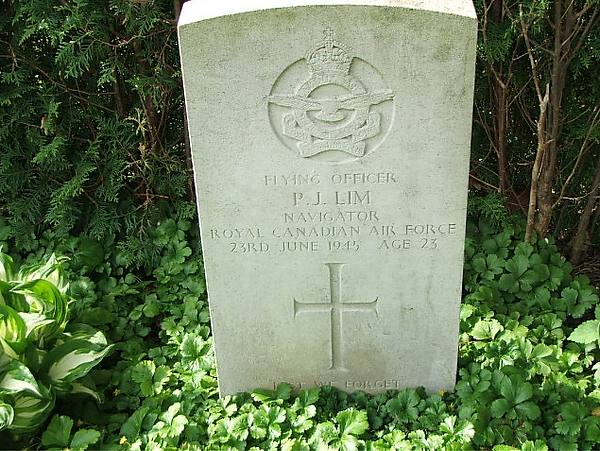
Pete's grave, Enschede Cemetery, Netherlands. From The Canadian Virtual War Memorial.
According to the court of inquiry, Pete had not been authorized to fly that morning. The conclusion was the accident was due to an error of judgment by the pilot following a disobedience of flying orders. Orders going forward were given that a third person was never to be carried in a night fighter Mosquito.
In March 1945, Harry Lim underwent an operation for bowel cancer in St. Joseph's hospital and a second one the next month with a grim prognosis. It is unknown whether Pete knew about it. In dire financial straits, Margaret found a job with a pharmaceutical sales company. Harry recovered, but was still in the hospital a year later and once released, he was unable to work. Further tragedy befell the family on August 14, 1949. Frank drowned in the undertow at Gibraltar Point on Toronto Island. He was with his sister and a friend who were unable to save him. Harry, Margaret and Mary continued to live on Danforth through the 1950s. Harry was eventually able to find work again as a chef and died in 1963. The next year Margaret moved to Etobicoke to live with Mary who had married. She ultimately returned to Edinburgh where she died in 1973.
(Many thanks to Peter Lim's nephew, David Hagelaar, for his family history assistance.)