
Documenting the WWII Fallen of Toronto's Elementary Schools
Clifford Lionel Hope

(Not mentioned on Danforth Park's Roll of Honour, but is mentioned on Maurice Cody's.)
Details of Clifford Hope's family and his early life are sketchy. His father John Campbell Hope was born in Bristol, England in 1888 and he was a painter/decorator. Clifford's mother Gladys Hilda Morley was born in Hackney, a borough of London, England in 1890. The couple met in Canada and were married in Windsor, Ontario on July 19, 1911. They had a son named Raymond in 1913 and Clifford was born in Brantford, Ontario on September 28, 1916. He spent his first few years in Brantford and another brother, Leonard was born in 1920. At the time of the 1921 census, the family was living in Toronto with Gladys' parents at 58 Myrtle Avenue, near Jones Avenue, just south of the railroad.

Danforth Park is the only school listed on Clifford's enlistment papers. From Library and Archives Canada.
When Clifford enlisted in the RCAF, he stated that he had attended Danforth Park school from 1923 until 1930. This is the only firm evidence that he was associated with the school. His family is not found in the Toronto city directories for the 1920s but in the late 1920s, Clifford's grandmother Elizabeth Hope was living at 274 Chisholm Avenue. Clifford's family is found in 1933, living at 81 Gledhill Avenue, but they were not recorded at this address in 1930. Clifford is commemorated on Maurice Cody School's Honour Roll, but his parents were living in North Toronto after the war which might account for this.
When Clifford left Danforth Park, he found a job as a clerk in a grocery store. In 1933 he started a job as a mechanic's assistant in a garage. A baby brother, Russell, was born in 1934. Hamilton's Mercury Mills were hiring in 1935 and Clifford moved to Hamilton to be a knitter in the mill. It appears that his parents and Russell joined him. In his spare time Clifford liked to golf, play hockey and baseball. He also played rugby in a league and liked to build model airplanes. He changed jobs again in 1940 and became a plate puller and machinist for The Steel Company of Hamilton.
Clifford wanted to join the RCAF when the war started, but discovered that at the time the force was only recruiting licenced pilots. He took up flying with the Hamilton Flying Club and he was awarded his pilot's licence in November 1940, flying 10 hours solo. That same month he joined the reserve of the Argyll and Sutherland Highlanders of Canada and completed his training by the end of the year.
Clifford and his family moved to Freeman, now a neighbourhood of Burlington. He was finally able to enlist in the RCAF on July 13, 1942. A week later he was in Lachine, Quebec to start his basic training. Although he had a pilot's licence, the RCAF's aptitude tests must have indicated that he was suited to be a gunner. On September 19, he reported to No. 6 Bombing and Gunnery School (BGS) in Prince Edward County, Ontario. It is unusual that he was sent straight to gunnery school as the average recruit spent four weeks at Initial Training School and was next given 50 hours of basic flying instruction at an Elementary Flying Training School. At No. 6 BGS, Clifford learned how to aim bombs and shoot a machine gun at a moving target. On February 21, 1943 he continued his training at No. 9 BGS in Mont-Joli, Quebec on the south shore of the St. Lawrence River near Rimouski, graduating with his air gunner's badge on May 14. He was promoted to Sergeant that day. He immediately returned home for his two week embarkation leave. His parents had moved to North Toronto, but he also visited his friends in Hamilton.
He reported to Halifax to await a ship to Britain. He embarked on June 16, arriving in Britain on June 24, when he reported to the Personnel Reception Centre in Bournemouth. On July 6 he was sent to No. 81 Operational Training Unit (OTU) where crews were trained on Whitley night bombers. The RCAF in Canada did not train using operational bombers and this would have been the first time Clifford was a gunner on a large plane. No. 81 was located at RAF Ashbourne, 30 kilometres east of Stoke-on-Trent in central England. The OTUs were where crews were assembled, mainly at a social gathering after the men arrived where they could get to know each other and team up. The crews were multinational. Clifford certainly joined the crew of air bomber Douglas Raymond Irvine, a 31 year old Torontonian from the west end who went to Humberside Collegiate. It is not known whether they joined a crew with the others that day, but ultimately Clifford's crew was comprised of 20 year old Australian pilot Ian MacDonald Scott, English navigator Samuel Joseph Peek, 20 year old wireless operator Sydney George Parrott from southern England and 20 year old Australian air gunner Kenneth Edgar Foxcroft. The air force had described Clifford as “wiry” and he was in the tightly fitting rear air gunner's seat.
By the end of August, the crew had graduated from the OTU and Clifford had leave until September 18, probably spending it in London as most airmen did. When he returned on September 18, he joined his crew at No. 1656 Heavy Conversion Unit at RAF Lindholme in South Yorkshire. They learned to fly the Lancaster, a four engine heavy bomber, unlike the Whitley's two. The crew also gained a flight engineer, Charles William Collishaw, a 20 year old Englishman. They finished their training in mid-November and joined RAF's No. 97 Squadron.

Lancaster bomber. Note the isolated rear gunner turret in the tail. Vic Jay Collection.
No. 97 was located at RAF Bourn, 11 kilometres west of Cambridge. It was a pathfinder squadron. The planes didn't bomb targets, they dropped flares on the targets so that the bombers following had something to aim at. The crew trained for several weeks before becoming operational. Their first mission on December 3 was to light up Leipzig, Germany along with 15 other Lancasters from the squadron. Clifford's plane took off at 1740 hrs. Once over the target, they dropped six flares of various sizes. They experienced barrage flak and they spotted enemy fighters between Hanover and the European coast. They arrived back safely at 0045 hrs.
After this successful mission, Clifford had a week's leave to December 13. The squadron didn't fly again during that period, mainly due to poor weather and the next sortie was December 16. The reality that a bomber crew's life could be a short one was ever present. On the December 3 mission, one of the squadron's Lancasters didn't return. It must have been in the front of air bomber Douglas Irvine's mind on the 16th as he penned a note leaving his personal effects to an air force friend.
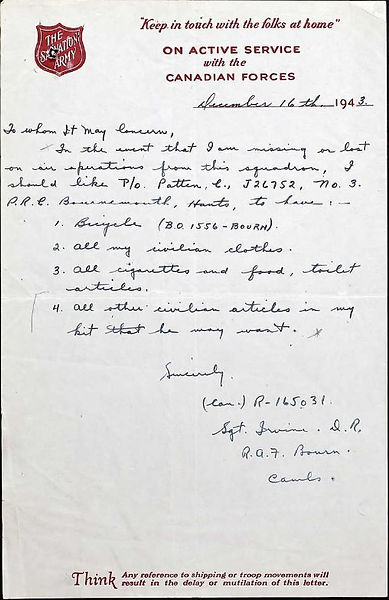
Note written by Clifford's air bomber Douglas Irvine on December 16, 1944. From his service file, Library and Archives Canada.
The Squadron was to drop flares on Berlin. The crew took off at 1650 hrs and although it was cloudy over the target, they released their flares and returned home. When they approached the base, the cloud was low at 120 metres and there was fog, rendering visibility very bad. They were diverted to RAF Graveley, 15 kilometres away. At 0101 hrs on December 17, their Lancaster crashed two kilometres northeast of the airfield. All aboard were killed instantly.
The squadron's record book noted that it was “a disastrous night” and it became remembered as “Black Thursday.” Of the 21 Lancasters that flew out, only 13 returned safely, although many were very low on fuel. One crew was reported missing, two crews bailed out rather than land in the fog, and four others crashed on landing. The squadron lost 35 men that night and all but 7 were because of the poor visibility when they landed.
Clifford and many of the others were buried on December 22 in Cambridge City Cemetery with a full military funeral and a large number of the squadron in attendance, including the station commander and flight commanders. Clifford's parents continued to live in North Toronto. Gladys passed away in 1957 and John followed her the next year. Listed in Clifford's personal effects was a signet ring with his initials and inside it was inscribed “Carole 1942.”