
Documenting the WWII Fallen of Toronto's Elementary Schools
James William Green

James Green's father, James Sr was born August 1, 1892 in Oldbury, near Birmingham, England. He immigrated to Canada as a young man, before the First World War. When he enlisted in the Canadian army in 1916, he was living in East Toronto at 2384 Gerrard Street East near Victoria Park Avenue and he made trunks. James Sr became a gunner with the 71st Battery and saw action in France. When he returned to Canada, he was able to return to his old address and found work at the train yard near Main and Danforth. There he met William Smith who also worked in the yard and lived nearby at 42 Wayland Avenue. He had a sister (or daughter – records leave it unclear) named Emily who was a year younger than James Sr and he introduced them. Emily had been born in the Channel Islands and may have spent some of her childhood in India. She had arrived in Toronto before the war, like James Sr, and during the war she worked in a factory on Pape Avenue. When she met James Sr, she was working as a looper in a hosiery factory. A looper worked a machine that closed the toe hole in socks or stockings.
James Sr and Emily married at St. John's Norway church on October 18, 1922 and they moved in with William and his wife. On May 11, 1924, James was born in the family house at 11 Iona Avenue which is southeast of Woodbine and Danforth. At the time, James Sr was a boilermaker's helper at the rail yard and eventually became a boilermaker, fixing the steam engines of locomotives. By 1927, the family had a new son, Kenneth Roy and had moved into a new house at 166 Barker Avenue.

166 Barker Avenue in 2009, rebuilt circa 2017. From Google Street View.
James' school history is somewhat cloudy. In his RCAF file, it is typed that he attended Danforth Tech from 1930 to 1940. This was probably an error on the typist's part and should have read “Park” instead of “Tech.” James did attend Danforth Park and in the article “How one British man's quest for his father's crewman led him to Canada” by Ellen Samek in the November 5, 2018 Toronto Observer (formerly The East York Observer), the Danforth Tech archives were investigated but no obvious evidence was found to indicate that James had ever attended. His school career probably ended after graduating from Danforth Park. James admitted that he left school when he was sixteen, but he may have had a late start at Danforth Park and hence a late graduation.
James was a keen photographer and liked to bowl, roller skate and play baseball and softball. He had mumps as a child. He claimed in his air force file that he apprenticed for three months with sheet metal, but didn't complete the apprenticeship. He worked for a moulder called James Morrison from 1939 to 1942 and then landed a union job at the rail yard in Leaside in shipping and receiving.
He enlisted in the RCAF on January 14, 1943. He stated that he had two years of experience working on a farm and wanted to be an animal farmer after the war. He did his basic training and aptitude tests in Toronto. On July 11, he transferred to the air force headquarters in Ottawa. Since James didn't have the necessary educational qualifications, he was sent to Ottawa Technical High School for his pre-aircrew education course, where he did very well in Mathematics and Aircraft Recognition. He graduated on August 25 and joined the Service Flying Training School at Uplands airfield near Ottawa. He trained on Harvard and Cessna Crane aircraft. By this point, James was deemed best suited as an air gunner, so on October 1 he moved to the No. 1 Air Gunners Ground Training School in Quebec City where he took a six week course in the use, care and maintenance of machine guns used on aircraft.
From November 15 until December 23, James attended Bombing and Gunnery School in Macdonald, Manitoba, where he won his Air Gunner's badge and was given a promotion to Temporary Sergeant. He came home to Toronto for the Christmas holidays on a two week leave, then reported to the newly opened No. 4 Aircrew Graduate Training School in Valleyfield, Quebec on January 6, 1944. Having completed the course, James was sent to Lachine, Quebec on February 11 to await a ship to take him to Britain.
He went overseas on March 5, 1944, disembarking at Liverpool, England on the 14th. He remained in Bournemouth, England at the Personnel Reception Centre for two weeks while his assignment was determined, then was sent to the No. 22 Operational Training Unit (OTU) at RAF Wellesbourne Mountford, located 6 kilometres east of Stratford-upon-Avon. Here aircrew were trained on Wellington aircraft for night bombing raids and James became a rear gunner. On June 21, James moved No. 61 Base at Topcliffe in North Yorkshire. It was an RCAF group training base which was comprised of the base station at Topcliffe with three sub-stations at Dishforth, Dalton and Wombleton. Here the crews got up to speed on Halifax bombers. On July 30, James and his crew mates joined No. 432 Squadron, which was located at RAF East Moor, about 30 miles southeast of Topcliffe. The 432 was also known as the Leaside Squadron because Toronto's Leaside neighbourhood had adopted it. James and his crew would be flying the squadron's Halifax B.Mk VII bomber, which the squadron had only been using since June. The only major change from the previous Halifax version was the engines. It carried a crew of 7.

Halifax bomber, showing the rear gunner's bubble in the tail. From www.airvectors.net.
James' crew was mostly assembled at 22 OTU and they would have started training together there. The mid-gunner was Stanley Ernest Zadorozny, a 21 year old from Sanford, Manitoba. He and James knew each other the longest, having trained together since Quebec City the previous October. They arrived in Liverpool on the same ship. The wireless operator/front gunner was 27 year old Alfred Goodman-Wells Blayney from London, Ontario. He arrived at 22 OTU the same day as James and Stanley. The navigator was Robert Leslie Cann, 22, from Winnipeg and the bomb aimer was Gordon Douglas Wilson, also 22, from Chatham, Ontario. The pilot was Max Krakovsky, a 21 year old who was born in Cobalt, Ontario, but grew up in Toronto. Once the crew moved from Wellingtons to the Halifax, they needed a flight engineer. This was RAF member Michael Joseph Boylan from Motherwell, Scotland.

Their first mission was August 7 and over the next four months they were sent over Germany to bomb some of the most difficult targets, successfully avoiding flak and night fighters. James wrote to his parents that on one trip the tail of the plane was hit by flak, missing him by two inches. Being a rear gunner was fairly dangerous as the glass bubble at the back of the plane could make the gunner a sitting duck.

The crew on leave. Sgt. Zadorozny, F/O Cann, F/O Krakovsky, James and F/O Wilson. From the David Mole collection, as provided for “How one British man's quest for his father's crewman led him to Canada” by Ellen Samek in the November 5, 2018 Toronto Observer.
On September 23, James was promoted to Flight Sergeant. By October the crew received a week's leave every month. Once they completed a tour of duty, which was usually considered 30 missions, they would be sent home to Canada, to teach new recruits. Only 25% of bomber crews were lucky enough to complete a tour.

James' Halifax, “Oscar the Outlaw.” From www.aircrewremembered.com.
James and the crew were one or two sorties short of their tour when they took off in the morning darkness of December 18, 1944 in their plane, nicknamed “Oscar the Outlaw.” Once again, they were to bomb German targets. At 0600 hrs the plane was over Rocroi, France, near the Belgium border, when it collided with an RAF Halifax. Both aircraft fell to earth. Pilot Krakovsky later recounted that the plane caught fire and the floor under him fell away. He fell with it and looked up to see his plane on fire. He parachuted into a group of American soldiers fighting the Battle of the Bulge and was able to get back to RAF East Moor on December 27. Unfortunately the other fourteen crew members on the two planes did not survive. James' body was never found. He is memorialized on the Runnymede Memorial in England, the Bomber Command Wall in Nanton, Alberta and on a memorial to the two crews in Taillette, France, near the crash site.

In Tailette, France. From www.aircrewremembered.com.
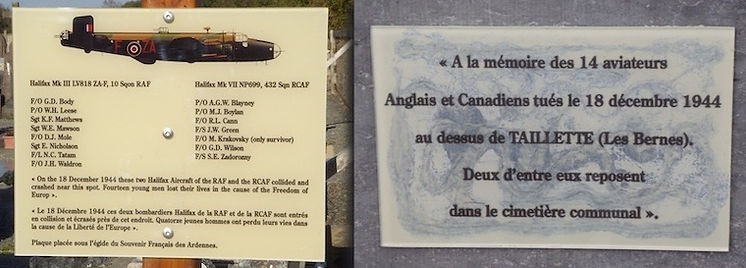
Detail from the Taillette memorial. From www.aircrewrmembered.com.
Max Krakovsky, who changed his last name to Carson, suffered survivor's guilt. He made it his mission to visit the families of his crew and he knocked on the door of 166 Barker Avenue, providing James' parents with information about the crash and stories of James. James' passion for photography had continued while he was in the air force. In his effects which were returned to his parents, there was a roll of film, a camera and a book Guide to Photographic Chemicals.
James Sr and Emily lived on Barker Avenue for many years. Brother Kenneth and his family lived next door at 164 Barker. James passed away in 1972. Emily lived on the street until she left to live in a retirement home in Bracebridge.